




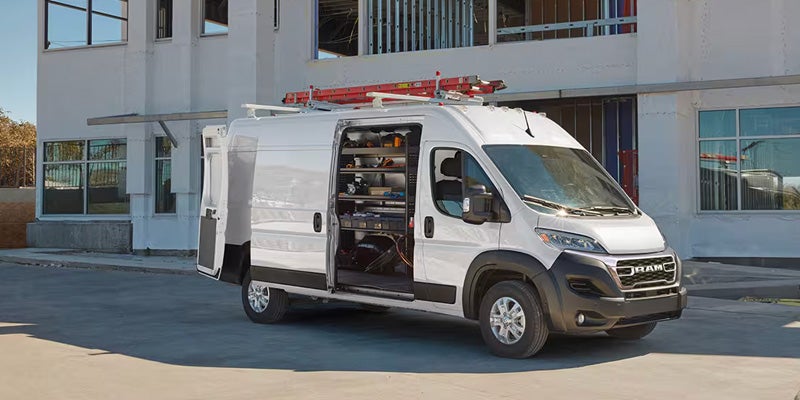
Choosing between the 2026 Ram ProMaster Gas vs. ProMaster EV comes down to one question: what does your route actually demand? A contractor hauling equipment through rural Putnam County has very different needs than a delivery operation running tight loops around downtown Carmel. Both vans wear the ProMaster name, but they're built for different jobs. We work with fleet managers and small business owners across Carmel, Poughkeepsie, Brewster, and Mahopac every week, and this breakdown reflects the questions we hear most often. You can also browse our new commercial inventory now.
2026 Ram ProMaster: Choosing the Right Powertrain for Hudson Valley Businesses
The 2026 Ram ProMaster lineup splits into two distinct paths. The gas ProMaster runs on a proven V6 and delivers the payload and towing numbers that heavy-duty operations depend on. The EV gives up some of that hauling muscle in exchange for lower running costs and a quieter ride, which works well for businesses sticking to local, predictable routes.
For Hudson Valley businesses, geography matters as much as spec sheets. A route that stays within Carmel's town limits looks nothing like one that stretches out toward Cold Spring or across the state line into Danbury, CT. Before comparing numbers, think honestly about how many miles you drive each day, how heavy your loads run, and how much flexibility your operation actually needs.
Key Specs Comparison: ProMaster Gas vs. ProMaster EV
Below is how the two powertrains stack up on paper, based on Ram's published specifications for the 2026 model year.
| Powertrain | Torque/Horsepower | Payload | Towing | Cargo Volume | Range/MPG |
|---|---|---|---|---|---|
| Gas (3.6L Pentastar V6) | 276 hp / 250 lb-ft | Up to 4,750 lbs | Up to 6,910 lbs | Up to 524 cu ft | Owner-reported 14-20 MPG |
| ProMaster EV | 268 hp / 302 lb-ft | Up to 3,170 lbs | Not published | Comparable cargo configs | Up to 164 miles combined |
The gap in payload and towing is the biggest differentiator here, and it's the number most fleet managers ask about first.
Powertrain Performance: V6 Towing Power vs. Instant Electric Torque
The gas ProMaster's 3.6L Pentastar V6 produces 276 horsepower and 250 lb-ft of torque, paired with a TorqueFlite automatic transmission and front-wheel drive. It's a well-established combination Ram has refined over years of commercial use. The EV counters with a 200-kW electric motor generating 268 hp and 302 lb-ft of torque, delivered instantly from a standstill.
That instant torque advantage isn't just a spec sheet talking point. In stop-and-go traffic, it means smoother, more responsive acceleration without the lag of a traditional engine building power. Businesses running frequent short stops, delivery drivers hopping in and out every few blocks, for example, tend to notice the difference right away.
Gas ProMaster: Highway Range and Heavy-Duty Capability
The gas ProMaster still holds the edge for long-distance work. Since it runs on conventional fuel, refueling takes minutes rather than hours, and the van isn't limited by charging infrastructure availability. With a 10,000-mile oil change interval and best-in-class 36-foot turning diameter, it handles both highway stretches and tighter job-site maneuvering with ease. For businesses covering ground between Carmel, Brewster, and Poughkeepsie, that flexibility matters.
ProMaster EV: 110-kWh Battery and 164-Mile City Range
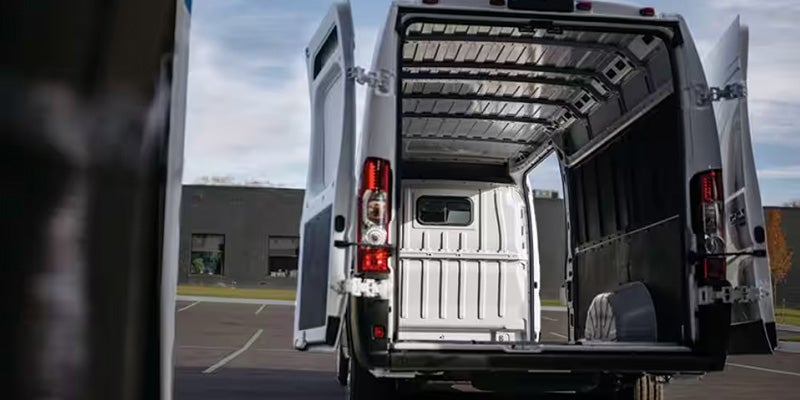
The ProMaster EV is built around a 400-volt, 110-kWh battery pack. Ram's manufacturer estimates put combined range at up to 164 miles when loaded at 50% payload, with city range estimated up to 161 miles. That range comfortably covers most local delivery loops within and around Carmel, but it requires planning around charging access, especially for businesses without a home base to plug in overnight.
Ram offers three charging options: Level 1 (120V top-off), Level 2 (240V, full overnight charge), and Level 3 DC fast charging. Per the U.S. Department of Transportation, Level 2 typically brings a battery-electric van from empty to 80% in 4-10 hours, while DC fast charging reaches 80% in as little as 20 minutes to an hour. If you want to feel the difference in torque and cabin quiet for yourself, scheduling a test drive is the easiest way to judge fit.
Payload, Cargo, and Upfit Capabilities for Local Fleets
Payload capacity often decides this comparison before range or performance even enter the conversation. Businesses hauling tools and equipment need to know exactly how much weight they can carry without exceeding GVWR limits.
Payload and Towing Limits Compared
The gas ProMaster's payload tops out at 4,750 lbs, with towing capacity reaching 6,910 lbs depending on configuration. Ram lists the EV's max payload at 3,170 lbs. If your business tows trailers or hauls heavy equipment regularly, that payload gap alone often settles the decision in favor of gas.
Cargo Configurations and Upfit Options by Powertrain
The gas ProMaster comes in three roof heights (66", 77", and 86") and four cargo lengths up to 13 feet. A low-roof extended wheelbase configuration offers 4,430 lbs of payload paired with 304 cu ft of cargo volume, a useful middle-ground setup for businesses balancing space and weight. Both powertrains come in Tradesman®, SLT, and SLT+ trims, so upfitters have flexibility regardless of which engine you choose. Our team can walk through upfit options in person if you stop by to view the new Ram vehicles for sale in Carmel, NY.
Operating Costs for Putnam and Westchester County Routes
Total cost of ownership is where the EV starts closing the gap, at least for the right kind of route. Fuel and electricity pricing in New York directly affects which powertrain makes more financial sense over time.
Fuel and Charging Costs Per Mile
According to the U.S. Energy Information Administration, New York's regular gas price has recently run around $3.35 per gallon, dipping as low as $2.86 over the past year. New York's average commercial electricity rate sits near 22.4 cents per kWh, with a statewide commercial benchmark of 23.49 cents per kWh reported for February 2026. For businesses running high daily mileage, that per-mile cost difference adds up fast, particularly on routes that stay within the EV's range and can rely on overnight Level 2 charging.
Maintenance Savings and Available EV Incentives
The ProMaster EV's simpler drivetrain means fewer moving parts and less routine maintenance compared to the gas V6, which still needs oil changes every 10,000 miles.
On incentives, it's worth being precise. The federal EV purchase tax credit is no longer available for vehicles placed in service after September 30, 2025. State programs and Section 179 treatment both depend on how the van is configured, so ask our commercial team what currently applies and confirm the tax side with your accountant before you budget.
Matching the Right ProMaster to Your Business Route
Spec sheets matter, but your actual route determines which van earns its keep.
Best for Downtown Carmel Deliveries and Tight-Street Navigation
A delivery business running repeated loops through downtown Carmel, with predictable mileage and access to overnight charging, is a strong match for the ProMaster EV. The instant torque helps with frequent starts and stops, and the 164-mile range comfortably covers a full day of local runs without needing a midday charge.
Best for Long-Haul and Rural Hudson Valley Routes
Gas ProMaster territory looks different: a contractor towing equipment across rural Putnam County, say, or a route that runs out to Poughkeepsie or Danbury, CT on a regular basis. The extended range, higher payload, and towing capacity remove the range anxiety that comes with longer, less predictable driving patterns.
Many businesses we work with don't fit neatly into one category; they run a mix of tight local deliveries and occasional long hauls. In those cases, we help fleets configure a mixed gas and EV lineup, matching each van to the specific route it'll run rather than forcing a one-size-fits-all decision.
Frequently Asked Questions About the 2026 Ram ProMaster Lineup
How far can the 2026 ProMaster EV travel on a single charge?
Ram's manufacturer estimate puts the ProMaster EV's range at up to 164 miles combined when loaded at 50% payload, with city range estimated up to 161 miles. That's typically enough for a full day of local delivery routes around Carmel and surrounding towns.
Is the gas ProMaster better for towing and long routes?
Yes. The gas ProMaster offers up to 6,910 lbs of towing capacity, while Ram hasn't published a towing figure for the 2026 ProMaster EV. For long-distance or towing-heavy work, gas remains the stronger choice.
What are the payload differences between gas and EV models?
The gas ProMaster's max payload reaches 4,750 lbs, compared to up to 3,170 lbs for the ProMaster EV. That difference matters most for businesses hauling heavier equipment or bulk inventory regularly.
Are there fleet incentives for choosing the ProMaster EV?
New York's Drive Clean Rebate can offer up to $2,000 toward a qualifying new EV purchase or lease. Note that the federal EV purchase tax credit is no longer available for vehicles placed in service after September 30, 2025, so we'd recommend confirming current state and local programs before budgeting.
Talk to Meadowland of Carmel CDJR's Commercial Vehicle Team
Warranty Coverage on Both Powertrains
Both the gas and electric 2026 Ram ProMaster are backed by Ram's official coverage: the gas model carries a 10-Year/100,000-Mile Limited Powertrain Warranty, while the ProMaster EV includes an 8-Year/100,000-Mile E-Powertrain and Battery Limited Warranty.
Get Started
Whichever powertrain fits your routes, our commercial vehicle team can help you configure the right ProMaster, or a mixed fleet of both, based on your actual delivery patterns and load requirements. Reach out through our contact form or start a fleet financing application today, and let's find the setup that fits your business.