




Blog / CDJR Vehicles

Which 2025 CDJR Work Vehicle Is Built for Your Needs? Explore Ram, Jeep & More

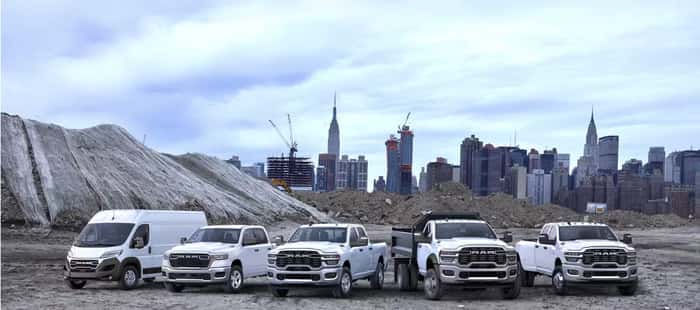
2025 Ram Commercial Lineup

If you run a business in or around Carmel, New York, the 2025 commercial Chrysler, Dodge, Jeep, and Ram vehicles may interest you. Whether your operation requires a robust work truck for the job site, commercial vans for transporting passengers or cargo, or off-road-ready vehicles for adventures, we've got you covered. At Meadowland of Carmel Chrysler Dodge Jeep Ram (CDJR), our range of commercial vehicles has something for everyone, including flexible financing options to fit your business' budget. To learn more about what's on offer and get advice on your next purchase, feel free to contact us today.

2025 Ram Work Trucks and Vans

The Ram 2500 and 3500 are two Ram commercial trucks that are ideal for towing big loads. If your business focuses on moving freight or heavy equipment, look to one of these lines. The 2500 and 3500 trucks are powered by either a 6.4L V-8 engine that puts out 405 horsepower and 429 lb-ft of torque or a larger 6.7L six-cylinder turbodiesel with an impressive 430 horsepower and a maximum of 1,075 lb-ft of torque. If towing is your number one concern, the turbodiesel combined with a towing package may be a great choice.

The versatile configurations available on Ram work trucks meet a variety of needs. For example, you can opt for a regular cab with an extra-long cargo bed measuring 8 feet in length. Alternatively, you could choose the more spacious crew cab or the cavernous Mega Cab with a shorter cargo bed if you regularly need to transport more passengers. Numerous tow packages and other upgrades are on offer, including a gooseneck hitch, trailer cameras, and a multifunction tailgate for ease of access and convenience.

An alternative vehicle for your commercial needs is the Ram ProMaster van. The standard Ram ProMaster 1500 provides an expansive cargo area with a single row of front seats. The cargo area can be configured in various ways, whether that includes shelving and other storage features to carry your gear, converting the cargo area into a living space for longer journeys, or simply leaving it as it is to maximize its hauling ability. If you need to transport more passengers, you can add a second row of seats to increase its capacity by three people.

Chrysler, Dodge, and Jeep: Versatile Commercial Solutions

While Ram tends to be the preferred option for commercial buyers, there are vehicles in our Chrysler, Dodge, and Jeep inventories that may suit your business' needs. For example, the Chrysler Pacifica minivan combines the convenience of three rows of seating with a large cargo area, which you can expand with the 60/40-split folding rear row. This could be an ideal choice if you want a vehicle that can do double duty taking your family around town and hauling loads for your job.

Jeep vehicles are a good choice if your business involves transporting people or goods off the beaten track. With multiple models designed to handle rough terrain, Jeep offers comfortable ways to transport passengers, such as the three-row Grand Cherokee. You can equip it with off-road tires, running boards, and more. Alternatively, the compact Gladiator pickup is great for hauling smaller payloads, and it can more than hold its own when the pavement ends. And with two rows of seating, the Gladiator is a flexible vehicle capable of carrying passengers as well.

Dodge's Charger sedan and Durango SUV can be effective fleet vehicles for transporting passengers around Carmel or even New York City. The Durango's three rows of seats comfortably fit up to seven people and provides a decent amount of cargo space for suitcases or other luggage.

Finance Options for Commercial Buyers

We can offer attractive loan agreements with competitive interest rates and other terms so you can purchase new commercial fleet vehicles at a manageable cost.

Our team of financial experts at our Carmel, New York, dealership is always on hand to answer any questions you may have, help craft your loan package, and finalize your loan documents. Alternatively, our commercial leasing options allow you to benefit from the use of a vehicle for your fleet during its best years of performance without having to purchase it outright.

We can continue supporting your business needs long after you finalize your purchase. Our CDJR service center can provide routine maintenance and repair services for your fleet on an ongoing basis at an affordable price. Keeping up on oil changes and tire rotations can help your vehicles last longer. Regular multipoint inspections performed by our trained staff members also help identify any problems before they get serious, enabling us to take preventive measures. When we carry out repairs, we use the very best original equipment manufacturer parts to ensure your vehicle's performance.

Visit Meadowland of Carmel CDJR for Your Next Commercial Vehicle

We have lots to offer commercial customers here at Meadowland of Carmel CDJR. Whatever the size of your business, you can find new Ram, Chrysler, Dodge, and Jeep vehicles in our showroom. Ram commercial trucks for the job site, vans for transportation, and passenger vehicles for city commutes are all on offer. What's more, you can rely on the expertise of our finance and service teams for top-quality support during and after your purchase. If you'd like to learn more or get started with buying a commercial vehicle, feel free to contact us today.

Image from ramtrucks.com
Posted in:

Related Posts

What is a Vehicle Recall?

Have you received a notice that your vehicle has been recalled? Or are you just curious to know how recalls work? Vehicle recalls are an important safety mechanism to ensure that automakers take steps to resolve serious defects that pose a risk to driver safety. After repair work, recalled vehicles can safely return to the road. At Meadowland of Carmel in Carmel, New York, we handle vehicle recall repairs and often get asked questions about the process. We've compiled a guide to some of our customers' most common queries about recalls. What Exactly Is a Vehicle Recall? A vehicle recall is a decision by a manufacturer or the National Highway Traffic Safety Administration (NHTSA) to bring a car in for urgent safety repairs at a dealership. Recalls are typically issued voluntarily by the manufacturer because it can be fined heavily if it fails to do so. The manufacturer may issue a recall after reviewing warranty claims or receiving information from NHTSA about consumer complaints. Recalls will be issued using the vehicle identification number (VIN), which is usually on the lower corner of the windshield on the driver's side. The manufacturer must write to all affected vehicle owners within 60 days of issuing the recall. Mail may not reach all owners, especially if you bought the car used or changed your address recently. That's why it's worth checking NHTSA's website for relevant recalls by entering your VIN twice a year. There's no reason to be worried about your vehicle after a recall repair is carried out. Recalls are an important part of traffic safety regulations to help ensure that all cars on the road meet high standards. In rare cases, the issues raised by a recall may be so serious that the recalled vehicles must be scrapped. However, if this occurs, the manufacturer will repurchase the car from you so you won't lose out financially. How Do Vehicle Recalls Start? There are two main ways that recall is initiated. The first is when a manufacturer responds to repeated safety issues with a component or equipment. For example, Toyota recalled several hundred vehicles after some dealerships complained about cars with cracked engine blocks that were leaking fluid. The company traced the problem to a failed water flow meter at one of its plants, which resulted in the engine blocks not cooling properly. Toyota issued a recall for the affected vehicles. The other possibility is that NHTSA calls for a recall after conducting an investigation. Investigations are usually launched after the agency receives a large number of complaints about a specific problem. However, automakers have a strong incentive to take action themselves before NHTSA gets involved. The agency can fine a manufacturer up to $111 million if it repeatedly fails to respond to safety defects it was aware of. Are Repairs During a Recall Free? Yes, repairs on recalled vehicles that are 15 years old or less are typically covered by the manufacturer during a recall. The 15-year time limit starts when the vehicle is sold to its first buyer. Older vehicles may voluntarily be included in a recall by the manufacturer, but it isn't required to do so by law. If you take your car to a dealership and it tries to charge you for a repair, you should contact your manufacturer and explain the issue. Can I Drive My Car After a Recall? That depends on the type of recall. In some of the most serious cases, manufacturers will issue a “do not drive” notice, which means you shouldn't drive the vehicle until repairs are done. This may occur, for example, if defects in the braking system are detected. In other cases, you can drive your vehicle carefully and in essential situations. These could include driving it to the dealership for a recall repair. Other recommendations or orders may also accompany recalls. For instance, automakers have previously issued warnings to park vehicles outdoors after a potential fire risk was detected in their manufacturing. This information should be provided in the letter from your vehicle's manufacturer or mentioned on NHTSA's website. Can Vehicles Be Sold With a Recall? It's illegal to sell new vehicles subject to a vehicle recall. However, the same rules don't apply to used cars. As a result, you'll need to check the status of a used car before you purchase it. The best course of action is to make a note of the VIN and do a search for it on NHTSA's website. If the vehicle isn't subject to a recall, you should see a message explaining that there are no unrepaired recalls. How Long Will Recall Repairs Take? The length of time can vary considerably. Because a computer operates many parts of modern vehicles, some recall repairs can be conducted by owners simply by performing a software update. Others may take considerably longer, especially if many vehicles are involved. High demand for repairs by dealerships could result in parts shortages or delays in securing appointments. A delay may also be caused if a manufacturer issues a recall before a fix for the problem has been found. Vehicle manufacturers aren't obliged to provide a loan vehicle while recall repairs are carried out. However, it could be worth asking your dealership if a loan vehicle is available. It may be willing to provide one at its own expense if your repair takes longer. More About Vehicle Recalls at Meadowland of Carmel Now that you know a bit more about vehicle recalls, we hope you can understand how important it is to check regularly for any notices related to your car. If you need a recall repair, you can rely on our professional service and parts teams at Meadowland of Carmel in New York. We have the tools and know-how to perform auto repairs to the highest standard, and we'll also be happy to answer any questions you may still have about the recall process. Don't hesitate to contact us today to learn more.

What Models of Chrysler, Dodge, Jeep, and RAMs Will Be Electric Vehicles?

If you thought we'd seen the end of Chrysler, think again. Far from ready for retirement, the brand is enjoying a renaissance, and it couldn't have come soon enough. As Chrysler undergoes a unique evolution, the brand offers high-tech products to its customers with an all-new, all-electric lineup set to roll out by 2028. Brand CEO Chris Feuell recently lifted the lid on Chrysler's evolution at MotorTrend's 2022 CES show, revealing numerous plans for the future. These include revamping existing models and rolling out entirely new ones, emphasizing electricity and sustainability. From all-EV models to souped-up muscle cars and the transformation of the minivan, there's a lot to get excited about. Dodge, Jeep, and Ram also have several new electric offerings on the horizon for car-buyers to enjoy. Read on to see what these impressive electric plans include for customers. EV Models Chrysler Chrysler is developing the STLA Large electric vehicle platform on which their new, fully EV design and other upcoming models will be built. While they revealed the shiny new Chrysler Airflow Concept at CES, it seems to be at least two more years before their first fully electric vehicle hits the road. It's also unclear if the Airflow Concept will ever become a reality, with neither its production nor name confirmed. It seems likely, though, that the first Chrysler EV will mirror the design and aesthetic of the Airflow Concept to some extent. Borrowing from the design of the Airflow Concept, Chrysler's new EV SUV is likely to boast a 118-kWh battery pack. If that proves the case, it would also have a range between 350 and 400 miles. That said, a range of as much as 500 miles could be achievable for STLA Large platform vehicles. Despite the promises of new models, Chrysler is behind the times when releasing their EV. The trick now is creating genuinely new Chryslers. On the upside, we can expect real differentiation when these new models roll out for customers to see and enjoy. Long since known as a minivan brand, you're likely wondering what the transition to EV will mean for Chrysler, as rising SUV sales overshadow sales of the Pacifica, despite it being the only plug-in hybrid minivan currently available. While sales may have slowed, it would seem there's no way Chrysler is doing away with their beloved minivans. The family favorite will be transitioning into the EV age along with the SUV model. As with the newly designed fully EV SUV, Chrysler is doing more with the minivan than simply giving it an electric engine. Instead, it will enjoy a fresh, new design that will appeal to a broader market. While no specifics are forthcoming about what to expect from the new minivan, the popularity and saleability of the Pacifica mean it's likely to be around for a while yet. As for the Chrysler 300, it seems a next-gen version of the sedan is unlikely as Chrysler focuses on SUVs. The carmaker looks to roll out the first Airflow-esque full EV as soon as possible, with one or two electric SUVs arriving from Chrysler by 2028. These would likely be mid-sized SUVs, based on the capabilities of the STLA Large. There may also be a two- and three-row version of the same car model, similar to how Jeep has handled the new Grand Cherokee. RAM Also on the horizon alongside the EV lineup are hydrogen-powered vehicles. The company rolled out a new hydrogen-powered Peugeot e-Expert last year, along with the Opel Vivaro. By 2025, customers may be able to expect a full-sized Ram Promaster that's hydrogen-powered. Late 2023 should see the appearance of a Ram ProMaster van, fully capable of beating out competitive models from many other popular brands across the EV spectrum. It seems the Ram will also be able to rival other brands' EV offerings in terms of towing, range, charging time, and payload. While the hydrogen initiatives are being fueled by technology partner Faurecia, these may only be available as a fleet offering. An extension of this is set to be heavy-duty trucks and powertrains, both powered by hydrogen. Dodge With both the Dodge Challenger and Charger set to retire in 2024, a new muscle EV is in the works. 2024 is set to mark the replacement of Dodge cars with a beefed-up EV muscle car. Also, due to being built on STLA Large frame, it's possible Dodge's muscly new model will combine two motors to create an 800+ horsepower EV. Jeep Jeep has revealed the first of their fully electric models, set to be launched in early 2023 across Europe. The as yet unnamed model is part of the brand's long-term strategy to ensure all their European sales are complete electric by 2026. The unveiling of the new Jeep is a demonstration of how all Stellantis brands that don't already have fully electric models will be rapidly brought up to speed through the creation of new EV offerings. While the details of the first Jeep EV have yet to be finalized, the model is expected to be a little below the Jeep Renegade in size. In style, it marks the evolution of the trademark chunky Jeep style into something a little more contemporary, the trademark grille of the brand being closed off while the windscreen is shallower and more aerodynamic. For those who love the familiar car models, it's certainly good news, as it seems Stellantis is dedicated to ushering all brands into the age of EV. Charging Stations Near Carmel If you're toying with the idea of investing in a new EV yourself but are concerned charging would be an inconvenience, there are several EV charging stations in and around the Carmel area, including EVgo Charging Station in Carmel's Putnam Plaza Shopping Center and an Electrify America Charging Station in Newburgh.

Empty Fuel Gauge

Is Your Driving Style Hurting Your Fuel Efficiency?

You may already know that there are nearly endless ways to protect your vehicle from damage and maximize the efficiency of your ride. But did you know that the fuel type you select can also influence your vehicle's performance? If you want to make the most out of your ride and keep it running at its best for a long time, it's important to understand which type of fuel you should use and how your driving can affect your car's fuel economy. At Meadowland of Carmel, we want to make sure that your vehicle can always take you where you need to go. Read on to learn more about the different gas types and to determine how you can preserve your investment in a quality new or used vehicle. How Does Your Driving Style Affect Your Vehicle's Fuel Efficiency? There are a few ways that your driving can affect your vehicle's fuel efficiency. Some driving behaviors that can require more fuel include accelerating frequently, idling often, braking heavily, and driving at high speeds. You can also burn through fuel more quickly by carrying or towing extremely heavy loads. Generally, the harder your vehicle works, the more fuel it'll use. Your vehicle's fuel consumption can also depend on the amount and type of trips you take. Since you use a good amount of gasoline to start your engine, taking a collection of short trips where you turn the vehicle on and off can use more fuel than if you took one long trip without stopping, consider planning your drives with this in mind. Another way you can save on fuel is by limiting the amount of driving you do. Routinely using different types of transportation like walking, biking, or taking public transportation can save you some gas money for your most important trips. These options are great for shorter trips around town. Finally, a well-maintained vehicle can always run more efficiently than one that doesn't receive regular service. This is because your qualified mechanic can diagnose and fix any small issues with your vehicle before they become big problems. They can also determine if your vehicle is running at its most efficient and offer fixes if it isn't. To optimize your vehicle's power and performance, schedule service with our highly trained technicians today. What Are the Various Types of Fuel? You will typically see several fuel types at the pump. The commonly used regular fuel option is 87 octane. Octane refers to the stability of fuel or the amount of pressure at which the fuel will combust. Mid-grade gasoline offers around 89 octane, and premium fuel falls between 91 and 93 octane. If your vehicle has a diesel engine, which uses compressed air rather than a spark plug to ignite, you can also select specialty diesel fuel. How Do You Know Which Fuel To Use? The best way to determine which fuel to use is to check the user's manual for your vehicle. In your manual, you can find the minimum octane rating for your vehicle. If your ride requires premium fuel, the manual will say that. If not, there's no reason to select any gasoline other than the lowest-priced option. While your manual should have this information, you can also find it near the vehicle's gas cap or fuel gauge. You can always contact our certified service department if you have questions or are unsure about your vehicle's required fuel rating. Why Do Some Vehicles Require Higher Octane Fuel? If you've selected a vehicle with a high-output engine, it may need premium gasoline to work effectively. These powerful engines require a higher compression ratio, meaning they compress air and fuel into smaller, highly combustible sizes. With the added pressure and heat associated with high compression, you may need a fuel type that can stand extra pressure before igniting. Without it, you risk the engine igniting prematurely, negatively affecting your vehicle's performance. What Happens if You Put the Wrong Type of Fuel in Your Vehicle? You can rest assured that using the wrong grade of gasoline won't destroy your ride. However, it can create some negative consequences and diminish your vehicle's performance. If you want to keep your vehicle on the road for as long as possible, always use the proper grade. However, if you have a diesel engine, do not use gasoline; regular gas will ruin a diesel engine. If you accidentally put gasoline in your diesel vehicle, don't start it or turn if off immediately if you already have, and have it towed to a mechanic immediately. If your vehicle requires only the lowest fuel grade, a higher octane option shouldn't create any negative effects besides costing more money. If you use gasoline with too low octane, though, this can limit your power and efficiency. Since octane refers to the pressure at which gas can combust, lower octane fuels may not handle exceptionally high pressure as well as premium options. Luckily, modern vehicles have a sensor that can retune an engine to avoid premature ignition, limiting lasting damage. Still, it's a good idea to determine your vehicle's exact fuel needs before filling up. Does the Type of Fuel Affect a Vehicle's MPG Rating? As long as you use the proper gasoline for your vehicle, you shouldn't notice an effect on your vehicle's gas efficiency rating. The miles per gallon will not increase if you purchase a higher octane fuel. If you use a lower octane rating than required, your ride can, unfortunately, demonstrate diminished performance that can result in lower efficiency. Be sure to know which level is best for your vehicle before fueling up. If you'd like to upgrade your fuel efficiency rating, you can select a vehicle (and fuel) with a diesel engine. We want you to get the most out of your new or used vehicle at Meadowland of Carmel. Understanding which fuel to use is a great way to keep your ride in its best shape. To maximize the efficiency of your drive, be sure to browse our extensive collection of new vehicles and impressive pre-owned offerings to find one that meets your fuel economy needs. We can't wait to help you find a ride that exceeds all your expectations for efficiency, power, and drivability.